
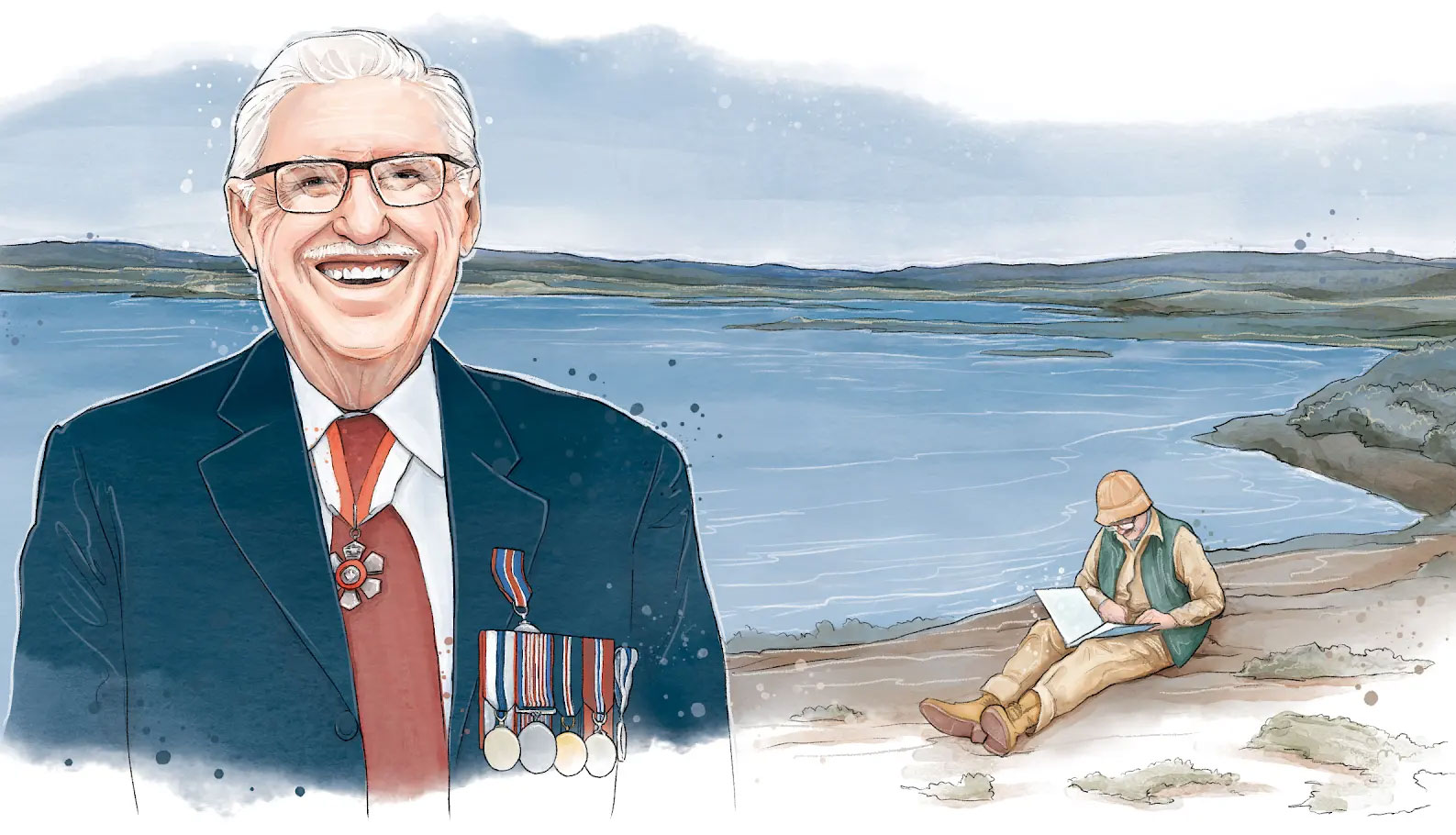
Imagine yourself under a vast dome of sky. Lakes stretch in every direction, and streams weave through the terrain, trying to find their way to the sea. The ground is carpeted in low-lying vegetation, with bursts of brightly coloured rhododendrons, but there are no trees. There is no traffic, no airplanes, no roads. You are entirely alone, completely immersed in this extraordinary scenery. Some people could be scared, but others are completely mesmerized and bewildered by its stillness and scale. I’m the latter.
From the late 1970s through the 1980s, I spent about two months each summer exploring the Coppermine River region and travelling westward towards Bluenose Lake with the Geological Survey of Canada. It’s hard to describe the emotions I feel when I am there, with incredible beauty surrounding me and no one else nearby. I just feel utter contentment.
Over the years, I had many assistants join me there. We’d walk 10 kilometres a day or more, collecting samples and taking notes, trying to explain the landscape we were looking at. Some students would never walk alone on the tundra, terrified by its vastness. Others would fall under its spell just as I did, longing to embrace solitude and work solo rather than in pairs — which is now discouraged due to safety risks.
I still remember the first time I studied aerial photographs of the region. The images didn’t make sense to me yet. I was lost, but I learned so much about the tundra in the years to come. In the process, I fell hopelessly in love with the place.